

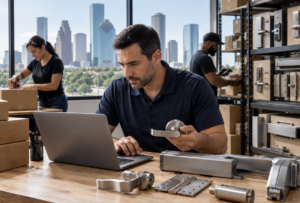
Houston’s ecommerce economy is changing the way local companies purchase products that once required phone calls, paper catalogs, and visits from sales representatives. Business owners, contractors, facility managers, property developers, and maintenance teams now expect to research products online, compare specifications, and make faster purchasing decisions without slowing down an active project.
Commercial door hardware is part of that shift.
A door handle or hinge may appear simple on a product page, but commercial buildings rely on a much larger system of locks, panic hardware, closers, exit devices, pivots, electronic access components, and specialty products. The wrong hardware can create maintenance problems, disrupt daily operations, or leave a business scrambling to replace a product that was never suited for the application in the first place.
For Houston businesses, the ecommerce advantage is not simply the ability to place an online order. The real advantage is having better access to specialized commercial hardware and information before making a purchase.
That is becoming increasingly important in a city with a large, diverse business economy. Houston is home to industries ranging from energy and manufacturing to hospitality, healthcare, logistics, technology, and retail. Each type of property creates different demands for doors, openings, security, and building access.
The ecommerce companies that understand those differences are changing the way Houston buys commercial door hardware. 🚪
Ecommerce Has Changed How Houston Businesses Source Building Products
Commercial purchasing used to move slowly. A business might contact a local supplier, explain the problem, wait for a callback, request information, and hope the appropriate product was available. For emergency repairs or active construction projects, that process could become frustrating.
Ecommerce has created a different expectation.
The U.S. Census Bureau’s retail ecommerce reporting shows just how significant online purchasing has become in the broader retail economy. U.S. retail ecommerce sales were estimated at $326.7 billion in the first quarter of 2026, representing 16.9 percent of total retail sales after seasonal adjustment.
Houston businesses are part of a larger purchasing environment where buyers are comfortable researching products online before contacting a company or completing a transaction.
Commercial door hardware fits naturally into this purchasing model, especially when an ecommerce supplier organizes products in a way that makes sense to contractors and business buyers.
A facility manager searching for a commercial door closer does not want to scroll through decorative residential hardware. A contractor looking for an exit device needs commercial-grade options. A business replacing a failed lock needs information that helps narrow the selection before the building’s security or operations are affected.
The ability to browse specialized categories can save time, but only when the ecommerce experience is supported by real commercial hardware knowledge.
The Products Houston Companies Are Looking for Online
The phrase commercial door hardware covers a surprisingly broad range of products. In an ecommerce environment, the most useful suppliers make it easier for business buyers to identify the type of hardware required for a particular opening.
Commercial locks remain a major category. Offices, retail stores, restaurants, warehouses, medical facilities, hotels, apartment properties, and industrial buildings all require locks, but the applications are rarely identical.
A basic storeroom function lock may be appropriate for one door while another opening requires electrified hardware connected to an access control system. High-traffic doors can also require products designed to withstand frequent operation.
Door closers are another important category. Businesses rely on closers to help doors return to the closed position after use. When a closer starts leaking, slamming, or failing to properly control the door, the problem becomes noticeable very quickly.
Panic hardware and exit devices are also commonly researched online. These products are associated with egress openings and require careful product selection. Buyers need to pay attention to the door, application, hardware configuration, and applicable requirements rather than treating an exit device as a generic product.
Hinges, pivots, flush bolts, thresholds, weatherstripping, door pulls, kick plates, continuous hinges, and specialty replacement parts also play an important role in commercial buildings.
Businesses browsing Commercial Door Hardware Houston products are often not shopping for a single decorative upgrade. They are trying to solve a building problem, complete an installation, replace worn components, or maintain a property where doors are used throughout the day.
That makes product quality and accurate selection especially important.
Houston’s Business Economy Creates Unique Hardware Demand
Houston is not a one-industry city. Although its connection to energy is known around the world, the regional economy includes a wide range of industries and business services.
The Federal Reserve Bank of Dallas overview of the Houston regional economy notes the city’s ongoing economic diversification and reports that business services grew 14 percent from 2016 through 2023, becoming Houston’s largest employment cluster.
Growth and diversification create a wide range of commercial properties.
Warehouses need durable hardware capable of handling demanding environments. Hotels may require hardware that combines security with frequent guest and employee use. Retailers need dependable entrance and back-of-house door systems. Medical and professional offices often manage multiple access points with different levels of restricted entry.
Restaurants put significant wear on doors separating kitchens, storage areas, offices, and exterior spaces. Industrial facilities can have heavy doors and challenging operating conditions.
Houston’s climate also matters. Heat, humidity, heavy rain, and severe weather can create additional concerns for exterior doors and hardware. Corrosion resistance, proper closing, weather protection, and long-term durability should not be afterthoughts.
An ecommerce buyer may begin by searching for a simple replacement part. The better purchasing decision considers how the opening is actually used.
A door opened several hundred times during a business day is not operating under the same conditions as a rarely used storage room door. Commercial hardware needs to match the demands placed on it.
Online Buying Is Moving Closer to Houston’s Physical Retail Economy
One interesting ecommerce trend is the connection between digital purchasing and physical infrastructure.
Houston-area retail businesses have continued experimenting with fulfillment models built around online orders. A Houston Chronicle report on H-E-B’s Katy ecommerce fulfillment center described a 100,000-square-foot facility designed to support rising demand for online shopping in the Houston area.
The lesson reaches beyond groceries.
Ecommerce increasingly depends on warehouses, distribution networks, commercial facilities, delivery operations, and physical buildings. Those properties contain doors that must open, close, lock, secure inventory, and control access.
The digital economy still has a very physical side.
Every fulfillment operation has employee entrances. Warehouses have service doors. Distribution properties contain secured areas. Retail locations manage stockrooms and receiving entrances.
As Houston’s online purchasing environment grows, commercial facilities remain an important part of the system behind the screen.
That means the demand for dependable commercial door products is unlikely to disappear simply because more business is conducted online. Ecommerce can actually make specialized hardware easier to find and purchase.
📦 The order may happen online, but the hardware still has to perform on a real door in a real Houston building.
Houston Retailers Are Blending Online and In-Person Experiences
The line between ecommerce and traditional retail continues to get thinner.
A Houston Chronicle article on Perigold’s Houston storefront reported that the digitally launched home furnishings brand selected Houston for its first physical store in part because of its strong local online customer base.
This type of shift demonstrates an important point for business suppliers. Customers may discover a company online, research products digitally, and still value access to knowledgeable people when making a more complicated purchase.
Commercial door hardware is a good example.
An ecommerce site can make the initial search easier. Product categories, photographs, descriptions, and technical information can help a buyer identify possible solutions.
Commercial applications, however, can get complicated.
Door handing, fire ratings, backsets, finishes, functions, mounting requirements, dimensions, power requirements, and compatibility can all affect the final selection. Two pieces of hardware that look nearly identical on a screen may be designed for completely different installations.
The strongest commercial ecommerce model combines digital convenience with industry knowledge.
That approach allows the website to serve as a purchasing tool without pretending that every commercial door problem can be solved by clicking the first product in a search result.
Why Cheap Hardware Can Become an Expensive Ecommerce Purchase
Price comparison is one of the biggest benefits of ecommerce. It can also create a problem when buyers focus entirely on the lowest visible price.
Commercial hardware has to survive commercial use.
A less expensive product may appear attractive during checkout, but the total cost changes when hardware fails prematurely. A replacement can involve more than the cost of another product. Businesses may also deal with labor expenses, operational disruption, emergency service, lost employee time, or temporary security concerns.
The cheapest closer is not a bargain when it cannot handle the door.
The least expensive lock is not a smart purchase when it does not match the function required for the opening.
Incorrectly selected exit hardware can create an even larger headache when the buyer discovers the product is incompatible with the existing door or intended installation.
Experienced contractors understand this, which is one reason commercial buyers often look beyond the product price.
Brand reputation matters. Product specifications matter. Grade and application matter. Availability of replacement components can matter several years after the original purchase.
An ecommerce supplier focused specifically on commercial hardware can make these considerations easier to understand.
Sales Tax and Online Orders Are Part of the Ecommerce Equation
Houston ecommerce buyers also operate within Texas sales tax requirements.
The Texas Comptroller’s guidance for online orders explains that online purchases and sales can be subject to sales tax and outlines responsibilities involving marketplace providers and marketplace sellers.
For businesses, ecommerce purchasing is now part of normal accounting and procurement activity.
This is another reason established commercial buyers prefer clear transactions and organized purchasing records. Online ordering can make it easier to review purchases, locate order information, and manage repetitive product needs.
A property management company responsible for multiple buildings may purchase similar products throughout the year. A contractor may repeatedly need certain commercial hinges, closers, or locking products.
A well-organized ecommerce relationship can reduce the amount of time spent starting the purchasing process from the beginning every time a product is needed.
Convenience becomes especially valuable when a business is managing multiple jobs or locations.
Houston’s Distribution Strength Supports the Growth of Ecommerce
Houston has a long history as a transportation and distribution center. That position is increasingly important in an ecommerce economy that depends on the movement of physical products.
The City of Houston’s economic development information specifically identifies the city’s distribution economy and notes Houston’s role in major distribution activity.
Commercial door hardware buyers benefit from the same broader purchasing expectations affecting other industries. Businesses want to locate products efficiently and reduce unnecessary delays.
A broken commercial door component rarely fails at a convenient time.
A closer starts leaking before a busy weekend. A lock stops operating properly when employees need access to a secured area. A hinge problem becomes worse as a heavy door continues to sag. An exit device begins sticking in a high-traffic area.
Online product access gives buyers the ability to begin researching a replacement immediately.
That does not eliminate the need for accurate product selection. It simply removes unnecessary barriers between identifying a problem and finding a possible solution.
For busy Houston companies, that difference can matter.
Commercial Buyers Need More Than a Basic Product Catalog
The ecommerce sites that serve commercial buyers well tend to understand that business purchasing is different from casual consumer shopping.
A business owner is not buying a door closer because shopping for door hardware sounds entertaining.
The buyer probably has a door that is slamming.
A contractor looking for panic hardware likely has a project schedule.
A property manager ordering a continuous hinge may be dealing with a heavy door that has become a recurring maintenance problem.
Commercial searches are often driven by a specific need.
This is why specialized product selection and clear organization can be so valuable. Buyers need to quickly move toward products relevant to commercial applications.
Houston’s ecommerce landscape also continues to show how online purchasing can create secondary retail opportunities. The Houston Chronicle’s coverage of Houston-area “bin stores” examined how growing volumes of ecommerce returns are supporting an unusual resale model built around returned and liquidated online merchandise.
For commercial hardware buyers, the takeaway is different but related. Ecommerce creates an enormous amount of product choice, and not every purchasing path offers the same level of certainty.
Commercial businesses generally need the right product, not a mystery bargain.
Detailed information, recognizable manufacturers, and access to commercial expertise carry real value.
The Future of Commercial Door Hardware Buying in Houston
The future of commercial door hardware purchasing will likely become even more digital, but knowledgeable service will remain important.
Buyers are becoming more comfortable researching technical products online. Product information is easier to access. Contractors can search for hardware directly from a jobsite. Facility managers can begin researching a failed component while standing in front of the door.
Mobile purchasing has changed expectations.
At the same time, commercial buildings are becoming more sophisticated. Electronic access control, electrified locking products, automatic operators, and integrated security systems create applications where compatibility becomes increasingly important.
The winning ecommerce suppliers will not simply have the largest number of products.
They will help buyers navigate those products.
A massive catalog without organization can create confusion. A specialized commercial hardware ecommerce experience can shorten the distance between a building problem and the appropriate product.
For Houston businesses, that combination of online access and specialized knowledge is becoming increasingly valuable.
Conclusion
Houston businesses are purchasing differently than they did a decade ago. Ecommerce has made it easier for contractors, property managers, facility teams, and business owners to research commercial building products without waiting for a traditional sales process to begin.
Commercial door hardware is part of that change.
Locks, exit devices, closers, hinges, pivots, access control components, and specialty products can now be researched online with far greater convenience. The challenge is making sure convenience does not replace proper product selection.
Houston’s diverse commercial economy creates demanding door applications. A busy restaurant, industrial property, hotel, warehouse, medical office, and retail store do not necessarily need the same hardware.
The best buying decisions begin with the actual door, the way it is used, and the problem that needs to be solved.
Ecommerce gives Houston businesses faster access to commercial hardware. Specialized knowledge gives them a better chance of buying the right product.
When those two things work together, online commercial hardware purchasing becomes more than convenient. It becomes a smarter way to keep Houston businesses open, secure, and operating. 🔐