

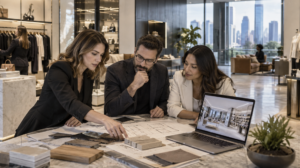
Online Branding Now Has a Physical Counterpart
A company may spend years developing a recognizable ecommerce identity through typography, photography, packaging, color palettes, product presentation and digital advertising. When customers finally enter that company’s physical location, they expect some continuity.
This creates a new challenge for interior designers. The objective is not simply to copy a website and turn it into a room. Digital design and architectural design operate under entirely different conditions. One exists on a screen. The other has scale, movement, light, sound, texture and physical limitations.
The role of a Dallas Architectural Interior Designer can therefore include translating the personality customers recognize online into a physical environment that feels consistent with the brand while still functioning naturally as an actual retail space.
A minimalist ecommerce brand might use restrained materials, open sightlines and carefully placed products rather than filling every available wall. A luxury retailer might rely on lighting, texture, custom millwork and more deliberate circulation. A highly visual lifestyle company may create spaces specifically designed to encourage photography and social sharing.
The strongest physical environments do not imitate digital branding. They interpret it.
Dallas Provides a Significant Market for Retail Experimentation
The scale of the Dallas market is one reason these changes matter. Wikipedia’s overview of Dallas places the city within one of the largest metropolitan areas in the United States and reports substantial economic activity across the region. That size gives national companies, emerging brands, entrepreneurs and established retailers access to a broad consumer market.
Economic activity also continues to support commercial investment. The Federal Reserve Bank of Dallas reported during 2026 that Dallas employment had increased and noted the region’s continuing importance as a destination for corporate relocations and expansions.
Those conditions help create a marketplace where different kinds of retail concepts can coexist. Luxury stores, national chains, independent boutiques, digitally native companies and established Texas brands can all compete for attention.
That competition raises expectations for physical design. A functional storefront may no longer be enough when neighboring businesses are using architecture, lighting, materials and experiential features to communicate their identity.
Texas Ecommerce Activity Is Growing Alongside Traditional Retail
Statewide figures also illustrate the strength of digital commerce. The Texas Comptroller of Public Accounts reported that electronic shopping, vending machine and direct sellers generated more than $4.37 billion in fiscal 2026 sales tax receipts through the period reported, an increase of 13.27 percent from the prior year.
Electronic shopping was not replacing the entire retail economy. Traditional categories continued producing significant economic activity as well.
That combination is important because it demonstrates why the future of retail is less about choosing between ecommerce and physical stores and more about connecting them.
A shopper may purchase online and pick up locally. Another may examine an item in a showroom before ordering a different size online. Someone may discover a product through social media, visit the store, photograph the experience and purchase later from the company’s website.
Each interaction contributes to the same customer journey.
Retail Interiors Are Becoming Part of the Content Strategy
One of the less obvious consequences of ecommerce growth is the growing relationship between physical design and digital content.
Retail interiors routinely appear on Instagram, TikTok, Pinterest, Google Business Profiles, ecommerce websites and online publications. Customers photograph displays, mirrors, walls, signage and products. Businesses film promotional videos inside their locations. Influencers use stores as backgrounds. Brands photograph seasonal merchandise without leaving the property.
As a result, certain parts of the physical environment can serve two purposes simultaneously. They have to look good in person while also translating effectively through a camera lens.
Lighting becomes especially important. A beautifully designed store can appear dramatically different in photographs if the lighting produces harsh shadows or distorted colors. Backgrounds, sightlines and product placement can also influence how easily a business creates visual content.
Architecture is no longer experienced exclusively by the people standing inside it. A single photograph can expose a Dallas retail environment to thousands or even millions of people who have never visited Texas.
Showrooms Are Gaining Importance in an Ecommerce Economy
Ecommerce has also changed the relationship between inventory and floor space.
A retailer does not necessarily need every available product, finish, size or configuration physically displayed. The store can instead present selected products that communicate quality and help customers understand the collection while additional inventory remains available online.
That can create opportunities for more intentional showroom design.
Products have room to breathe. Customers can spend more time interacting with selected merchandise. Seating areas, consultation spaces and digital ordering stations can replace rows of inventory.
The store becomes a place for discovery rather than merely storage.
This approach can be particularly valuable for furniture, fashion, jewelry, specialty products, home goods and other categories where customers want to see, touch or experience an item before committing to a purchase.
Dallas Retail Construction Reflects Continued Investment in Physical Space
Despite the continued growth of ecommerce, physical retail development has not disappeared from Dallas.
Public project records from the Texas Department of Licensing and Regulation show ongoing retail renovation and interior construction projects in the Dallas market. Projects registered during 2026 have included remodels and interior build-outs involving retail locations at major shopping destinations.
The presence of continued investment in physical stores demonstrates an important point. Digital commerce and brick-and-mortar investment are not necessarily opposing forces.
Retailers may reduce certain locations while investing more heavily in the stores that remain. Others may open smaller experiential locations supported by centralized ecommerce fulfillment. Digitally native brands may decide that physical stores provide credibility, visibility and customer interaction that online advertising alone cannot create.
The result is a retail landscape where the quality and purpose of individual locations can become more important than simply maintaining a large number of storefronts.
Employment and Population Scale Support a Diverse Consumer Market
The Dallas-Fort Worth economy gives retailers access to an unusually large workforce and consumer base. Data from the U.S. Bureau of Labor Statistics shows millions of people participating in the Dallas-Fort Worth-Arlington labor market, with employment distributed across professional services, construction, manufacturing, trade, transportation and numerous other industries.
That economic diversity matters to retail design because Dallas does not represent one narrow customer profile.
Some locations serve luxury consumers. Others depend heavily on professionals working nearby. Certain districts attract tourists and visitors, while neighborhood retail centers may depend primarily on residents. Ecommerce adds another layer by allowing Dallas-based companies to serve customers throughout Texas, across the United States and internationally.
A physical location may therefore communicate with two audiences at once: the people walking through the door and the much larger online audience encountering photographs and videos of the space.
Convenience Is Changing Interior Planning
Consumers who shop through multiple channels also bring different expectations into stores.
Someone collecting an online order does not necessarily want to follow the same path as a shopper browsing for thirty minutes. A customer making a return has another objective. Someone visiting for a product demonstration or consultation may need privacy and seating.
Modern interiors can respond by creating clearer zones for different activities.
Pickup locations can be positioned to reduce congestion. Checkout areas can accommodate traditional purchases and ecommerce returns. Consultation areas can give employees room to demonstrate products. Signage can help customers quickly understand where to go.
Good retail planning makes these functions feel intentional rather than added as an afterthought.
Physical Retail Can Build Trust That Ecommerce Starts
Digital commerce offers extraordinary convenience, but a physical environment can provide reassurance that is difficult to reproduce online.
Customers can inspect materials. They can speak with employees. They can see how a product feels, fits or functions. They can experience the company’s attention to detail firsthand.
That means architecture can influence brand trust.
A poorly maintained or confusing environment can create doubt even when the company’s website looks polished. A thoughtful, cohesive environment can reinforce the professionalism customers encountered online.
For newer ecommerce companies, a physical store can become evidence that the brand exists beyond advertising and product photography. For established retailers, redesigned environments can show that the company is evolving alongside changing consumer behavior.
Dallas Ecommerce News Will Increasingly Include the Physical Shopping Experience
The story of ecommerce is gradually becoming bigger than websites and delivery boxes.
Commerce now moves between screens and physical environments constantly. Customers research online and purchase in stores. They discover products in stores and order later from home. They make purchases online and return them to physical locations. They photograph physical environments and share those experiences through digital networks.
For Dallas businesses, that means architectural interior design is increasingly connected to ecommerce strategy.
Retailers need spaces that communicate brand identity, accommodate multiple types of transactions, generate compelling visual content and give consumers a reason to visit even when the same merchandise can be purchased from a phone.
The companies that recognize this connection can treat their physical location as another powerful part of the customer experience rather than viewing it as a separate channel.
Conclusion
Dallas ecommerce growth is not eliminating the need for thoughtfully designed retail spaces. It is changing what those spaces are expected to accomplish.
The modern Dallas retail environment can function as a showroom, fulfillment point, marketing asset, content studio, customer-service center and immersive expression of a company’s identity. Architectural interior designers are being asked to bring these functions together while preserving the atmosphere that makes customers want to spend time inside the space.
National ecommerce data, Texas retail figures and continued commercial investment throughout Dallas all point toward a marketplace in which digital and physical commerce are becoming increasingly interconnected.
For retailers, the opportunity is no longer simply to build a better store or a better website. The larger opportunity is to create a consistent experience wherever the customer encounters the brand.
As Dallas continues to grow as a commercial and retail center, the most memorable spaces are likely to be those that understand this new relationship. Ecommerce may begin on a screen, but increasingly, its influence can be seen in the lighting, layouts, materials, displays and experiences taking shape inside Dallas retail spaces.